Low-temperature coarsening of Ising ferromagnets


What happens when an Ising ferromagnet, with spins endowed with Glauber spin-flip dynamics, is suddenly cooled from high temperature to zero temperature? Surprisingly, this simple system gets "stuck" in one of the relatively large number of metastable states. In two dimensions, getting stuck occurs approximately 1/3 of the time, while in three dimensions, the ground state is never reached.

Long-lived diagonal stripe configuration of up (red) and down (blue) spins on the square lattice with periodic boundary conditions.

Here is a schematic picture of an L x L square lattice spin system which is stuck for a long time in a diagonal stripe configuration. Periodic boundary conditions are employed in both the vertical and horizontal directions. The diagonal state consists of a stripe of up spins (blue) and down spins (yellow) each of which wind once around the torus (square lattice with periodic boundary conditions) both in the circumferential and the toroidal directions. The width of these two stripes are both of the order of L. This diagonal stripe configuration has an anomalously long lifetime which scales as La, with a between 3 and 3.5. Amusingly, if the system reached the diagonal stripe state, the final state is the ground state of the system.


Survival probability.

Time dependence of the survival probability S(t) on L x L square lattices. Main graph: S(t) versus t/M10 to highlight the long-time exponential tail. Here Mk=< t k>1/k is the kth reduced moment of the time to reach the final state. Scaling sets in after S(t) has decayed to approximately 0.04. Inset: S(t) versus t/M1/10 to highlight the scaling and the faster exponential decay in the intermediate-time regime. This graphs shows that there are two distinct time scales which govern the behavior of S(t).
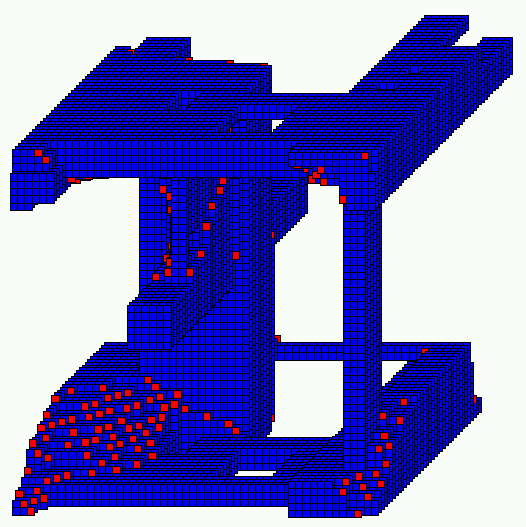

A 3-d metastable state.

A typical metastable of the three-dimensional Ising model on a finite cube with periodic boundary conditions in all directions. One phase of the spins are represented as blue unit-size cubic blocks. This spin cluster has a sponge-like topology so that there are no convex corners. The red blocks denote "blinker" spins which can flip indefinitely with no energy cost.


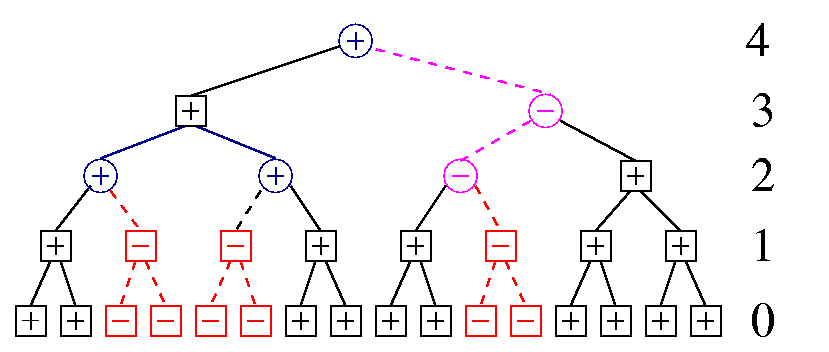
Metastables states of the Ising model on the Cayley tree.

A typical metastable state of the homogeneous ferromagnetic Ising model with Glauber dynamics on the 3-coordinated Cayley tree. At zero temperature these metastable states are actually stable. Shown are the first 4 levels of the tree. Spins in squares have their state uniquely determined by the states of the two "daughter" spins (black for + spins, red for - spins). Spins in circles are determined by the spin state of their parent (blue for + spins, magenta for - spins).


For details, see "Fate of Zero-Temperature Ising Ferromagnets", V. Spirin, P. L. Krapivsky and S. Redner, Phys. Rev. E 63, 036118-1--036118-4, (2001), and "Freezing in Ising Ferromagnets", V. Spirin, P. L. Krapivsky, and S. Redner, cond-mat/0105037 (submitted to Phys. Rev. E).


Sidney Redner <redner@bu.edu>
Last modified: Sat Jul 28 20:06:00 EDT 2001